JobMCQ Multiplayer Battle: A Competitive Quiz Game for Students and Job Seekers in Bangladesh
13 December 2025
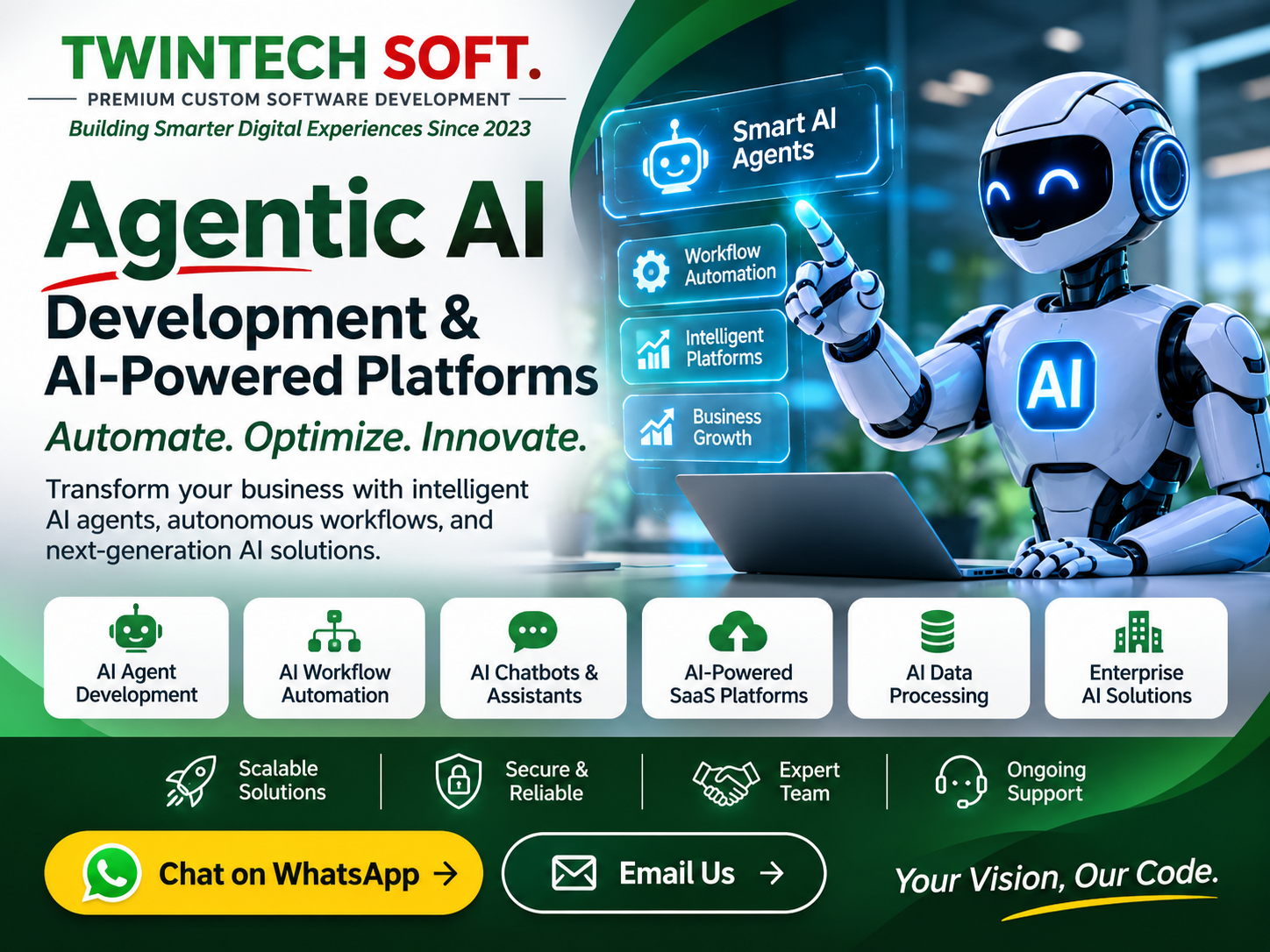
Artificial intelligence is moving beyond answering questions and generating content. Agentic AI enables intelligent systems to understand objectives, plan tasks, use tools, and execute multi-step workflows with varying levels of human supervision. Discover how AI agents work, their business applications, and how organizations can use agentic AI development to improve productivity and build smarter digital operations.
Agentic AI Development | AI Agents | Business Automation | Custom Software Development
Artificial intelligence has already changed how businesses communicate, analyze information, create content, and manage everyday activities. However, traditional AI applications often depend on users to provide instructions for individual tasks and manually complete the next steps.
A new generation of AI technology is taking things further. Instead of simply responding to individual instructions, intelligent AI agents can work toward defined objectives, break complex tasks into smaller steps, interact with external tools, and execute actions based on available information.
This approach is known as Agentic AI. It represents an important development in business automation because it allows organizations to build systems that can handle more complex workflows while keeping people involved in important decisions.
From customer support and sales operations to document processing, research, and internal business management, agentic AI creates new opportunities to improve productivity and operational efficiency.
For businesses exploring practical AI adoption, understanding how agentic systems work is an important first step toward building more intelligent digital solutions.
Agentic AI refers to artificial intelligence systems designed to pursue specific objectives by understanding instructions, planning actions, using available tools, and adapting their approach based on intermediate results.
Unlike a basic AI chatbot that primarily generates responses, an AI agent can interact with other software systems, retrieve information, perform supported actions, and coordinate multiple steps to accomplish a task.
For example, a business owner might ask an AI agent to research a potential customer, summarize their requirements, prepare a quotation draft, and create a follow-up task in a CRM system.
The AI agent can coordinate these activities through connected tools and predefined permissions rather than requiring the user to initiate every individual step.
This example demonstrates how an AI agent can coordinate multiple business activities. The actual level of autonomy depends on the system design, connected tools, permissions, and human approval requirements.
Agentic AI systems combine several technologies and software components to understand objectives and carry out tasks. Large Language Models (LLMs) often provide the reasoning and language capabilities, while tools, APIs, memory systems, and business integrations allow agents to interact with their working environment.
Although implementations vary, an agentic AI workflow commonly includes the following components:
Processes instructions, interprets context, evaluates available information, and selects suitable actions.
Breaks objectives into smaller steps and determines an appropriate execution sequence.
Connects to authorized APIs, databases, web services, and business applications to perform tasks.
Uses relevant conversation history, stored information, and retrieved business knowledge when available.
Performs permitted operations such as updating records, creating tasks, or generating reports.
Checks results, identifies incomplete steps, and adjusts the workflow when appropriate.
These components work together to create an intelligent execution cycle. Depending on the use case, the system may complete tasks independently within defined boundaries or request human approval before proceeding.
Traditional AI applications are often designed to perform specific tasks, such as generating text, classifying information, recognizing images, or answering questions. Agentic AI builds on these capabilities by introducing goal-oriented planning, tool usage, and multi-step execution.
| Comparison | Traditional AI | Agentic AI |
|---|---|---|
| Primary focus | Responding to individual requests or performing specific tasks. | Working toward defined objectives through multiple actions. |
| Task execution | Usually performs a predefined or individual operation. | Can coordinate a sequence of related operations. |
| Tool usage | May have limited or predefined integrations. | Can select and use authorized tools based on the task. |
| Planning | Generally follows a specific input-output pattern. | Can break objectives into smaller steps and adapt its approach. |
| Business application | Content generation, prediction, classification, and assistance. | Multi-step workflows, research, system coordination, and task execution. |
| Human involvement | Often requires users to initiate and coordinate each task. | Can reduce manual coordination while retaining appropriate oversight. |
It is important to understand that traditional AI and agentic AI are not competing technologies. Agentic systems often use traditional AI capabilities as part of a broader architecture. The right approach depends on the complexity and requirements of the business problem.
Agentic AI can support a wide range of business operations. Its value becomes particularly clear when a task involves multiple steps, different information sources, and interactions with existing software systems.
AI agents can understand customer inquiries, retrieve relevant information, classify requests, and coordinate support activities. Complex or sensitive cases can be escalated to human representatives.
Agents can qualify incoming leads, summarize customer requirements, update CRM records, prepare follow-up activities, and assist sales teams with customer communication.
AI agents can extract information from invoices, contracts, applications, and other business documents, then organize the results for further processing and review.
Agents can assist with order tracking, product information, customer requests, inventory monitoring, and coordination between connected eCommerce systems.
AI agents can assist employees with task coordination, internal knowledge searches, reporting, scheduling, and routine administrative activities.
Agents can collect information from authorized sources, organize findings, compare data, and prepare structured summaries for business teams.
These applications are examples of what can be developed with suitable AI models, software integrations, and business-specific workflows. Not every process needs an autonomous agent; sometimes a simpler automation solution is more practical.
A multi-agent AI system consists of multiple specialized AI agents that collaborate to accomplish a larger objective. Instead of relying on a single agent to handle every responsibility, businesses can divide complex tasks among agents with different roles.
For example, an organization developing an automated sales research platform could use separate agents for customer research, lead qualification, data verification, and report preparation.
Multi-agent architecture can help organize complex workflows, but it also introduces additional coordination, testing, and operational requirements. The number of agents should be based on actual business needs rather than unnecessary technical complexity.
When implemented around the right business objectives, agentic AI can improve how organizations manage information, coordinate tasks, and interact with their existing software systems.
Reduce the need for employees to manually coordinate repetitive multi-step activities.
Coordinate information and activities across multiple applications through authorized integrations.
Help teams retrieve, organize, summarize, and process information from different sources.
Apply defined processes, business rules, and validation steps across recurring operations.
Build workflows that can support growing operational demands with appropriate infrastructure.
Give employees more opportunities to concentrate on customer relationships, planning, and decision-making.
Building an effective agentic AI solution requires more than connecting an AI model to a chatbot interface. A reliable implementation needs a clear business objective, suitable AI models, secure integrations, well-defined permissions, and a software architecture that supports dependable execution.
Businesses should consider the following elements when planning an agentic AI development project:
Identify the business problem, expected outcomes, workflow boundaries, and tasks suitable for AI assistance.
Select suitable language models based on reasoning requirements, accuracy, latency, cost, and privacy considerations.
Determine whether a single agent, specialized agents, or a hybrid workflow is the most appropriate approach.
Connect the solution to existing databases, CRM platforms, ERP systems, and other business applications.
Implement access controls, authentication, data protection, audit logs, and restrictions on sensitive operations.
Monitor agent behavior, tool execution, errors, operating costs, and business outcomes after deployment.
Agentic AI development involves several technologies that work together to support reasoning, tool execution, information retrieval, and communication between software systems.
Models such as GPT and Claude can provide language understanding, reasoning, and tool-calling capabilities.
Frameworks such as LangChain, LangGraph, and CrewAI can help developers organize agent workflows and multi-agent interactions.
REST APIs, webhooks, and tool interfaces allow AI agents to interact with external software and business services.
Retrieval-Augmented Generation (RAG) and vector search can help agents access relevant information from business knowledge sources.
Backend services, databases, queues, and cloud infrastructure support secure execution and reliable system operations.
Monitoring and evaluation tools help developers track agent decisions, execution traces, failures, and performance.
The technology stack should be selected according to the project's complexity, security requirements, expected usage, and long-term maintenance needs. Using more frameworks or AI models does not automatically produce a better solution.
Although agentic AI offers valuable opportunities, autonomous execution also introduces technical and operational challenges. Businesses should address these considerations before deploying agents in important workflows.
AI models can generate inaccurate information. Use validation, reliable data sources, and human review for important outputs.
Agents may access sensitive business information. Apply authentication, least-privilege permissions, secure data handling, and audit logging.
Incorrect instructions or unexpected tool behavior can trigger unwanted operations. Use execution limits, approval checkpoints, and rollback mechanisms.
Connecting multiple applications requires careful API design, error handling, access management, and integration testing.
Model usage, repeated reasoning steps, external APIs, and infrastructure can increase operating costs. Monitoring and optimization are essential.
Financial transactions, legal decisions, sensitive customer operations, and other high-impact activities should have appropriate human supervision and clear accountability.
A successful agentic AI implementation is not simply about maximizing autonomy. It is about creating a reliable balance between intelligent execution, security, transparency, and human control.
Businesses do not need to transform every operation at once. A practical approach is to identify a specific business challenge, develop a focused AI agent, evaluate its performance, and gradually expand its capabilities.
Find repetitive or complex processes where an intelligent system could provide measurable value.
Establish its objectives, available tools, permissions, limitations, and expected outcomes.
Select appropriate AI models, development frameworks, databases, and integration methods.
Build the agent, connect required business applications, and implement security controls.
Evaluate normal scenarios, unexpected inputs, failed integrations, permissions, and agent behavior.
Track performance, operating costs, errors, and user feedback to improve the solution over time.
Agentic AI and traditional workflow automation can both improve business operations, but they solve problems in different ways.
Traditional workflow automation is often the better choice when processes follow predictable rules. For example, automatically sending an invoice notification after a payment is recorded does not necessarily require an AI agent.
Agentic AI becomes more useful when a task requires interpreting information, evaluating different possibilities, selecting tools, or coordinating multiple steps based on changing circumstances.
In many cases, the most effective solution combines both approaches. Traditional automation can handle predictable operations, while AI agents manage tasks requiring interpretation, planning, and flexible coordination.
An AI agent becomes significantly more useful when it can work with the actual systems and data a business depends on. However, integrating AI into existing operations often requires more than a standalone chatbot or subscription-based AI application.
Custom software development allows businesses to build AI-powered platforms around their specific workflows, user roles, data structures, and operational requirements.
For example, an organization may need an AI-powered management platform that connects its customer database, internal dashboard, mobile application, and reporting system. A custom solution can bring these components together within a unified architecture.
Explore our custom software development services to understand how tailored software solutions can support business-specific requirements and long-term digital growth.
Depending on the project, AI capabilities can also be integrated into web applications and mobile platforms, giving employees and customers access to intelligent services through familiar digital experiences.
Discover our web application development services and mobile app development services for building connected digital products with AI-powered capabilities.
Agentic AI is creating new possibilities for how businesses interact with technology. As AI models, integration capabilities, and software development approaches continue to evolve, organizations will have more opportunities to introduce intelligent systems into their everyday operations.
Future business applications may increasingly combine specialized AI agents, connected enterprise systems, and human expertise to support more complex workflows.
Potential developments include:
However, the future of agentic AI will not simply be about making systems more autonomous. Reliability, security, explainability, cost management, and responsible human oversight will remain essential to successful implementation.
Every business has different operational challenges, and the right AI solution should be designed around those requirements. At Twintech Soft, we believe technology should solve real business problems, simplify operations, and create opportunities for sustainable growth.
Whether you want to introduce an AI-powered assistant, automate complex business workflows, integrate intelligent agents into existing applications, or develop a complete AI-powered platform, choosing the right development approach is essential.
Our Agentic AI development and AI-powered platform services focus on building practical solutions that connect artificial intelligence with real business operations.
Develop intelligent AI agents that can interpret objectives, coordinate tasks, and interact with connected business systems.
Build tailored business platforms and applications that align with your operational requirements.
Create connected web platforms with intelligent features, business integrations, and scalable architecture.
Develop mobile applications that bring connected digital services and intelligent capabilities to users.
Our approach begins with understanding your business objectives, identifying suitable AI opportunities, evaluating integration requirements, and developing a solution that can evolve alongside your organization.
Agentic AI is a type of artificial intelligence designed to work toward specific objectives by planning tasks, using available tools, and executing multiple actions. Unlike a basic chatbot, an AI agent can coordinate activities across connected software systems.
Traditional chatbots primarily focus on responding to user messages. AI agents can go further by planning tasks, retrieving information, interacting with authorized tools, and executing multi-step workflows to achieve defined objectives.
Yes. Agentic AI can support customer service, lead management, document processing, research, reporting, and internal task coordination. The level of automation depends on the system's capabilities, integrations, and permission settings.
A multi-agent AI system uses multiple specialized AI agents that collaborate on a larger objective. Each agent can have a different responsibility, such as research, analysis, verification, or reporting, while an orchestration layer coordinates their activities.
Yes. Small businesses can use AI agents for customer inquiries, lead qualification, administrative tasks, information retrieval, and reporting. Starting with a focused use case is often more practical than developing a complex multi-agent platform immediately.
Agentic AI solutions may use large language models, agent frameworks such as LangChain, LangGraph, and CrewAI, APIs, databases, vector search, retrieval-augmented generation, and cloud infrastructure.
Yes. Depending on available integration methods, AI agents can connect with CRM, ERP, HRM, accounting, eCommerce, payment, email, and other business applications through APIs, webhooks, and custom integrations.
Agentic AI can be used responsibly when designed with appropriate security controls, restricted permissions, validation, monitoring, and human approval for sensitive actions. Businesses should evaluate potential risks before allowing agents to execute important operations.
Workflow automation generally follows predefined triggers and rules, while agentic AI can interpret information, plan actions, and adapt its execution based on intermediate results. Both approaches can work together in a business automation system.
The cost depends on the complexity of the AI agent, selected models, number of integrations, data requirements, security controls, infrastructure, and expected usage. A focused business assistant may require less development effort than a multi-agent enterprise platform. A project assessment is the best way to estimate the investment.
Some AI agents can execute predefined low-risk tasks with limited supervision. However, financial transactions, sensitive information, legal matters, and high-impact business decisions should include appropriate human approval and oversight.
Yes. AI agents can be integrated into existing web and mobile applications through backend services, APIs, and secure communication layers. This allows businesses to introduce intelligent capabilities without necessarily rebuilding their entire software platform.
Agentic AI represents an important step in the evolution of business technology. By combining artificial intelligence, task planning, software integrations, and controlled execution, organizations can build systems that support more than simple information processing.
From improving customer support and managing business workflows to coordinating complex activities across multiple applications, AI agents offer practical opportunities to make everyday operations more efficient.
However, successful implementation begins with identifying the right business problem. Not every task requires an autonomous AI agent, and the best solution may combine traditional automation, custom software, and intelligent AI capabilities.
Start with a clear objective, choose the right technology, implement appropriate security measures, and build a solution that can grow with your business.
Ready to explore the possibilities of Agentic AI for your business? Let's discuss your ideas and discover how AI agents, custom software development, and intelligent integrations can help your organization work smarter and achieve more.
Twintech Soft | Agentic AI Development & Custom Software Solutions